
Language Proficiency Levels
What is language proficiency and how can I assess my proficiency?
In the Immerse program, you’ll walk a steady path toward ever-increasing proficiency. Be patient with yourself—there’s so much you want to say and so much you want to understand, but there's no shortcut to fluency. Everyone begins with simple communication and gradually builds toward more natural, sophisticated interaction. This takes time, effort, and persistence. (Did we mention there are no shortcuts?)
A Three-Part Goal: Communicative, Cultural, and Relational
While communicative skill often gets the most attention, effective language users grow in three crucial areas:
- Cultural Proficiency – Understanding how to act and respond appropriately within the cultural context.
- Relational Proficiency – Building trust and connection with members of the community.
- Communicative Proficiency – Clearly and naturally expressing your thoughts in the target language.
You won’t have the advantage of growing up in this new culture—what feels instinctive to those around you will require focused learning for you. Immerse helps you pursue proficiency holistically across all three domains, so you're not just speaking the language, but engaging meaningfully with others who do.
ACTFL: The Gold Standard
The American Council on the Teaching of Foreign Languages (ACTFL) is the leading authority for defining and measuring proficiency. For a deep dive, we recommend reading their Proficiency Guidelines (especially pages 15–23 in the 2024 edition).
You can also track your growth using the self-evaluation tools at the end of each level in BEC: Becoming Equipped to Communicate. These checklists highlight the specific skills and competencies you should develop at each stage.
Here’s a simplified summary of ACTFL’s major proficiency levels:
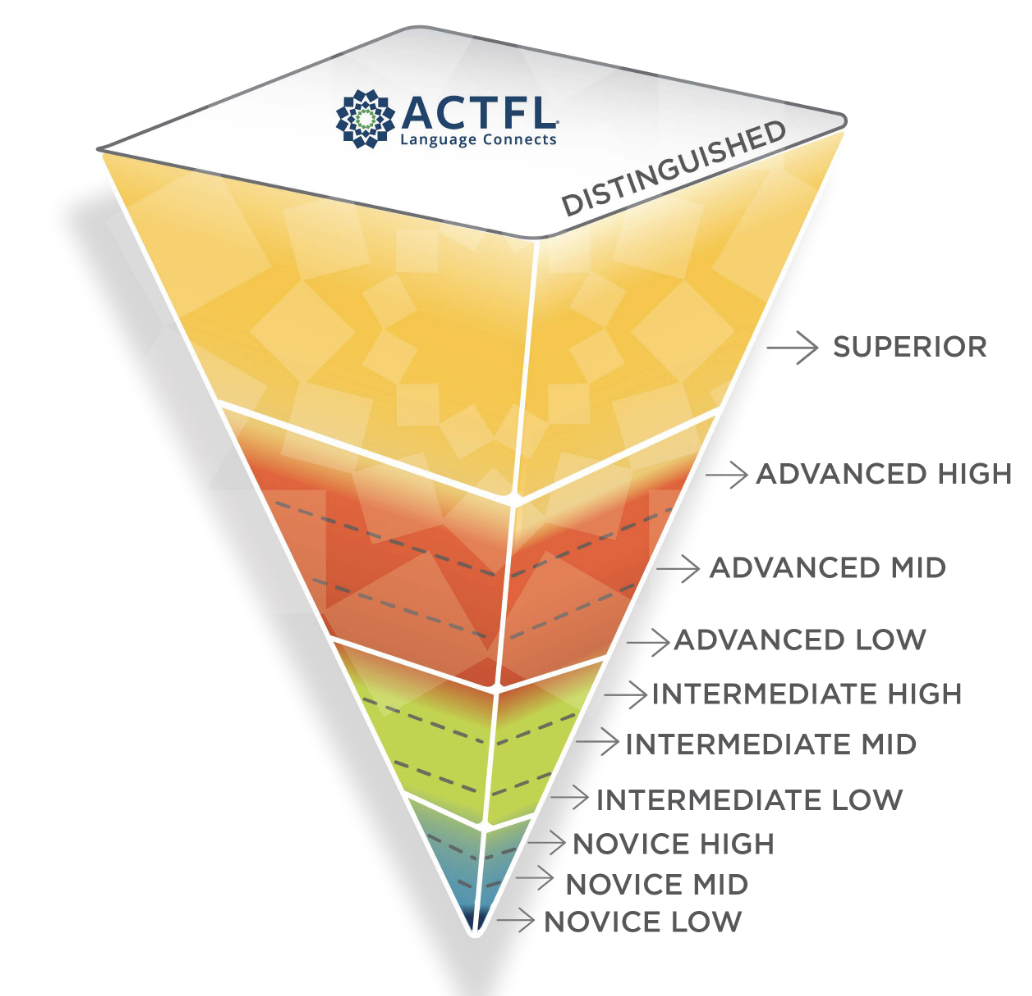
NOVICE
- Communicates basic messages on familiar, everyday topics.
- Relies on memorized words, phrases, and simple questions.
- Manages greetings, introductions, and rehearsed expressions.
- Limited understanding of cultural norms and heavy influence from their native language.
INTERMEDIATE
- Combines phrases and simple sentences to manage social interactions.
- Can ask and answer questions, talk about familiar topics, and navigate daily life.
- Speech consists of short, sentence-length discourse—mostly present tense.
- Can resolve misunderstandings and is beginning to adapt to cultural expectations.
ADVANCED
- Participates fully in routine and work-related conversations.
- Can describe, narrate, and express opinions across past, present, and future contexts.
- Uses paragraph-length speech with increasing fluency and control.
- Demonstrates growing understanding of cultural norms, and can talk about broader social topics.
SUPERIOR
- Communicates accurately and fluidly on both concrete and abstract topics.
- Can express complex ideas, support opinions, and engage in nuanced conversation.
- Uses figurative language, navigates formal and informal settings with ease, and handles unexpected situations.
- Makes few errors, primarily with advanced structures, and maintains excellent clarity.
Bottom Line:
Proficiency is more than vocabulary and grammar—it’s about fitting in, connecting deeply, and communicating meaningfully. Immerse will walk you through every stage of growth, so you can become a respected, relevant, and fluent member of your new community.